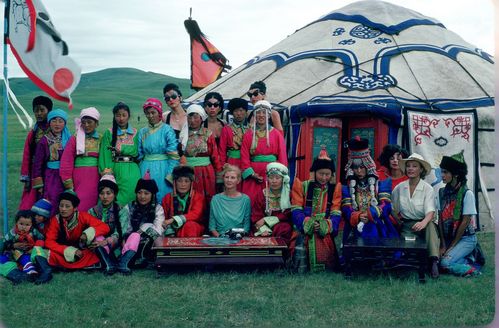
With Johanna d’Arc of Mongolia, Ulrike Ottinger has succeeded in creating a delightfully colorful and opulently charged mixture of an adventure film and ethnological documentary. The film begins with a ride on the Trans-Siberian Railway. Outside the window, a snow-covered landscape passes by. The viewer soon encounters the elegantly attired Lady Windermere, a British independent scholar and ethnologist, who is seated inside the luxury car. During the journey, she meets three other women: a German senior lecturer, an American Broadway singer, and the young French adventurer Giovanna, who is travelling in third class in the hopes of gaining an authentic picture of the foreign culture. Lady Windermere invites Giovanna to join her in the elegant dining car. Three men are also socializing there, and a Georgian female group plays music to entertain the guests. After an evening of drink and merriment, the colorful group parts ways in Ulan-Ude and the women travel on to Mongolia. At the behest of a princess, their train is later stopped by a group of Mongolian horsewomen, who kidnap the women. The female travelers eventually learn more about the archaic rituals of the Mongolian semi-nomads. In large-format panoramic shots, the viewers follow this dissimilar group of characters through the vast Mongolian landscape and experience how intercultural conflicts are overcome through respect, candidness, and human affection.
“Mongolia has always been a place of particular longing for me,” noted Ulrike Ottinger: “I not only looked for it; I kept researching it. It wasn't until I was far in the northeast that I found my location. It was an area with no infrastructure, but with green pastures and nomads who still lived in yurts.” Ulrike Ottinger’s own journey to film via painting is evident in the large-format panorama shots, which are as carefully composed as are landscape paintings. In the stream of opulent images, the viewer is carried away by the disturbing and intoxicating events and the film’s disparate protagonists.