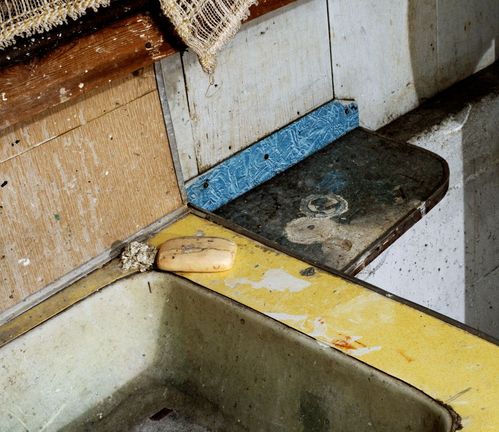
The work Diagonal Composition (1993) is the first in a series of three still lifes that Jeff Wall created in his Vancouver studio between 1993 and 2000. At first glance, the photograph resembles a snapshot of a chance everyday arrangement: it shows an old, stained sink set into a yellow counter. Resting on it are a dirty bar of soap and a crumpled piece of tinfoil. Beside it, a second black shelf—bearing the marks of cups or vessels—has been crudely nailed to the wall. Together with the wall paneling, splattered with paint, the interior creates a shabby impression that hints at a socially critical subtext.
However, the title Diagonal Composition suggests a different interpretation, pointing to a formal, compositional intent. The objects in the image are aligned along a diagonal axis cutting across the frame; combined with the varied materials of the wall paneling, they form an abstract collage that reminds art historians of the experimental photography of the “Neues Sehen” (New Vision) movement and of Cubist painting.
There is no right or wrong answer, as Jeff Wall’s work encompasses multiple layers of meaning.