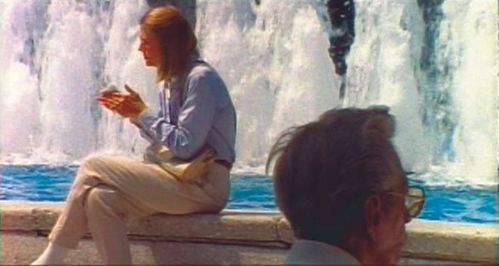
Colorful neon signs in Time Square. Motorcades pushing their way through the streets of Manhattan bumper to bumper, passing the facades of glass skyscrapers, whose windows are reduced to a geometric grid. Amid all this, crowds of people stream by – on their way to work, shopping, sightseeing – being channeled through the master plan of Manhattan, which gives them little opportunity to linger. With her film Midtown (1998), Sarah Morris created a film portrait of Manhattan that explores the interconnection of people and architecture. Everything seems to be in motion, guided by the strictly geometric layout of the international metropolis. Until the early 19th century, the fast-growing city of New York expanded uncontrollably on the island of Manhattan. In 1811, a government-appointed commission presented a unique urban development plan, which was simply referred to as “the grid”. It was visionary and modern, but also monotonous and brutal, with little regard for existing topography.
Morris shot Midtown in just one day in New York. It is the first in a series of city portraits in which she documents various forms of urban life in large American cities in an abstract, associative way. “The films began with the desire to capture the momentary, all those moments that elude the static form of documentation,” explained Sarah Morris in an interview.
The artist, who was born in Great Britain in 1967 and who lives in New York, became known for her monumental paintings – executed in house gloss paint – of strictly geometric structures that recall the facades of high-rise buildings. In her body of work, which includes paintings, films, graphics, and murals, Morris explores the influence of architecture, design, fashion, and advertising on modern life. “The films provide a kind of index of all the pictures I could have made and all the pictures I could still make,” Sarah Morris said. “They are a concentrated manifesto, a non-linear summary of what interests me.”