In the early 1990s, Jeff Wall visited the Alte Pinakothek in Munich, planning to create an image about the work of art restorers. Yet, limiting the subject to paintings on canvas did not align with his vision. While preparing for his solo exhibition at the Kunstmuseum Luzern in 1991, the museum's then-director, Martin Schwander, drew his attention to the Bourbaki Panorama. This panoramic painting—114 meters long and 10 meters high—was created by the Swiss artist Edouard Castres in 1881 and has been housed since 1889 in a building constructed specifically for it. It depicts a dramatic scene from the winter of 1871, at the end of the Franco-Prussian War, when the defeated French Army of the East, led by General Bourbaki, crossed the border into Switzerland. The painting illustrates the misery of war as well as the willingness of the Swiss population to help after the soldiers had been disarmed. Jeff Wall was fascinated by the panorama, as it represented a 19th-century mass medium that first awakened a desire for immersive, expansive visual worlds. He created a 120-degree panoramic photograph capturing the preparatory phase of the restoration—fully aware that a panorama cannot truly be rendered in a photograph. In this partially staged image, Wall combines the restorers’ work with shots of visitors who were unaware they were being photographed; in doing so, the present, future, and past appear to overlap.
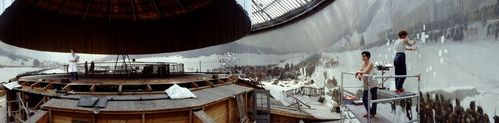
Restoration
- Year1993
- EditionEdition 2/2 (+ 1 a.p.)
- Material/TechniqueCibachrome, lightbox
- Dimensions137 x 507 cm
- CategoryPhotography