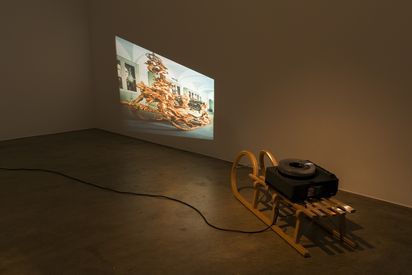
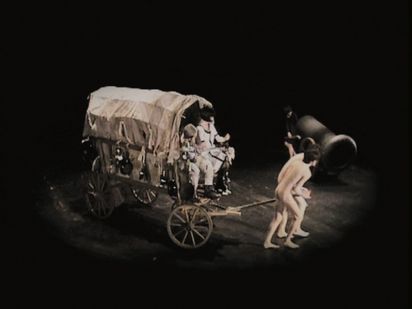
Richard Wagner’s opera Parsifal (1882) is an allegorical representation of human redemption through compassion. Graham’s engagement with Wagner’s work begins with a remarkable anecdote. In a scene from the first act, the hero Parsifal makes his way to the Castle of the Grail. During rehearsal, Wagner realized that his music and stage design were incompatible for this scene: the original 24-bar passage was too short to accommodate a stage change. Wagner’s assistant, Engelbert Humperdinck, then composed nine additional bars, creating a loop that could be endlessly repeated until both the set was prepared and Parsifal had reached the Castle of the Grail. Graham, drawing on a mathematical principle, added asynchronies to Humperdinck’s loop. Now, it takes 39 million years for all the voices in the score to synchronize again at their starting point. The sheer endlessness of Graham’s adaptation of the opera not only turns its already lengthy performance time into absurdity but also renders its central theme of redemption equally absurd.